




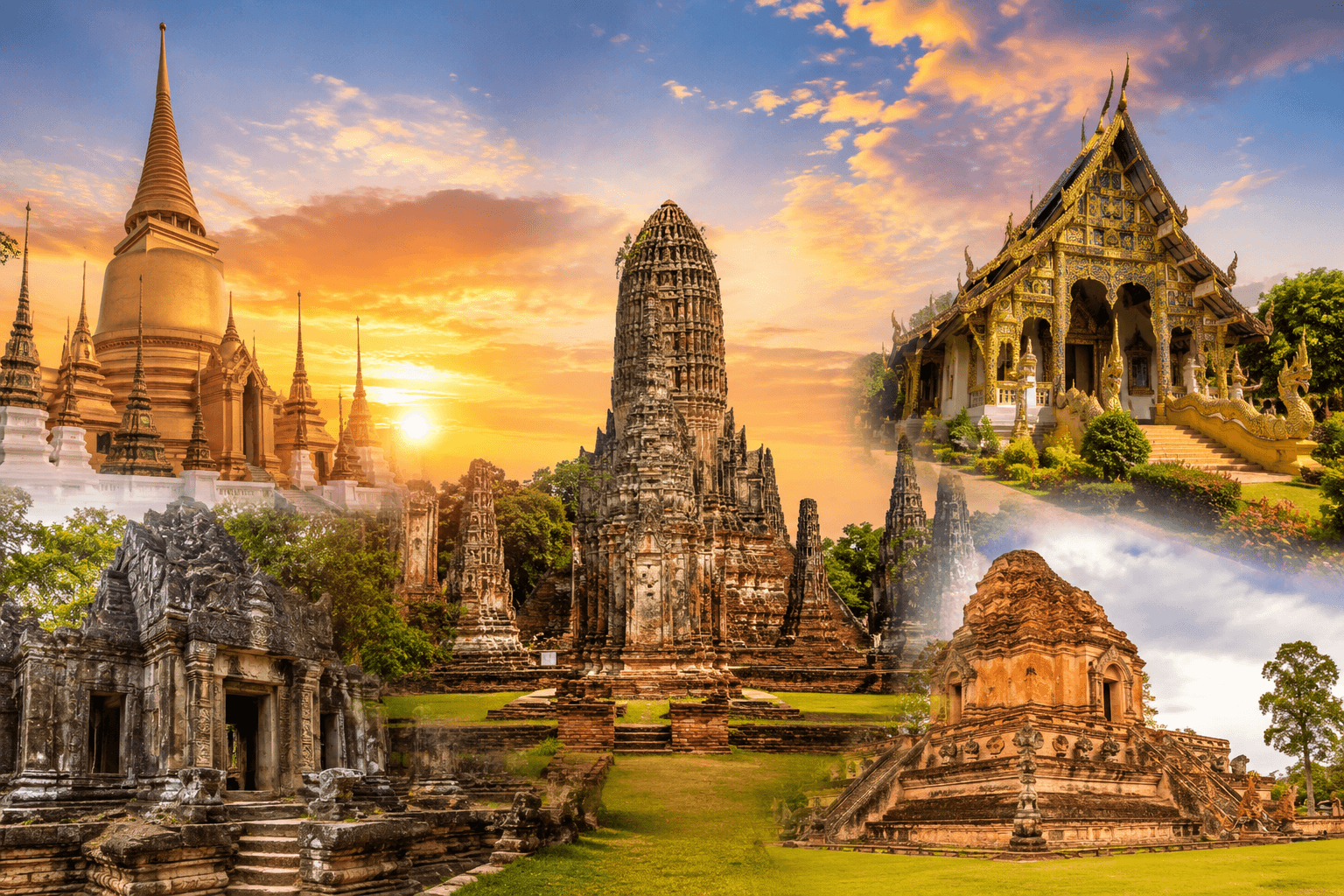
 Architecture
Thailand preserves some of the oldest and most architecturally significant archaeological ruins in Southeast Asia. Exploring this regional landscape reveals that the Top Heritage Sites Across Thailand offer some of the most profound historical experiences in the world. This overview offers a close look at these cultural hubs to help travelers plan a rewarding historical journey.
Travelers seeking deep historical connection will find that the Top Heritage Sites Across Thailand showcase centuries of artistic mastery and spiritual devotion. UNESCO formally recognizes multiple spots in the country for their outstanding universal value. These destinations protect ancient ruins, pristine forests, and prehistoric settlements.
Discovering the Historical Value of Top Heritage Sites Across Thailand
Ayutthaya Historical Park represents a central destination when listing the Top Heritage Sites Across Thailand. Founded in 1350, this ancient city served as the second capital of the Siamese Kingdom for over four centuries. The site spans 289 hectares and contains grand reliquary towers known as prangs alongside massive Buddhist monasteries.
Burmese invaders destroyed the capital in 1767, leaving behind majestic stone ruins that now form an archaeological park. Visitors can explore key ruins like Wat Mahathat, famous for the sandstone Buddha head entwined in tree roots. Wat Phra Si Sanphet features three iconic bell-shaped stupas that defined royal Ayutthayan architecture.
The site gained UNESCO World Heritage status in 1991 under criteria three. It lies about 80 kilometers north of Bangkok, making it accessible for day trips or extended historical study.
- Wat Chaiwatthanaram: A Khmer-style temple built in 1630 situated on the west bank of the Chao Phraya River.
- Wat Yai Chaimongkol: Known for its massive bell-shaped chedi built to celebrate a historic victory in 1592.
- Wat Lokayasutharam: Features a massive reclining Buddha image measuring 37 meters in length.
The Ancient Capital Charm of Top Heritage Sites Across Thailand
Sukhothai Historical Park stands out among the Top Heritage Sites Across Thailand due to its status as the first capital of Siam. Established in 1238, Sukhothai represents the dawn of Thai civilization and the birth of classic Thai art and architecture. The park encompasses 70 square kilometers and contains nearly 200 historical ruins within and outside its ancient city walls.
Architects of the Sukhothai era developed the unique lotus-bud chedi style, which distinguishes these ruins from Khmer-influenced structures. Wat Mahathat serves as the spiritual heart of the park, featuring a main chedi surrounded by smaller stupas. Another major attraction is Wat Si Chum, which houses a giant 15-meter-tall seated Buddha image visible through a narrow temple opening.
Sukhothai and its associated historic towns of Si Satchanalai and Kamphaeng Phet became UNESCO World Heritage sites in 1991. These towns collectively show the administrative, religious, and economic structures of the early Siamese state. Traveling between these sites requires a local bicycle rental or an electric tram ride.
- Lotus-bud Stupas: Elegant, tapering structures unique to the Sukhothai artistic style.
- Walking Buddha Images: Elegant bronze sculptures depicting the Buddha in motion with fluid, graceful lines.
- Loi Krathong Festival Origins: The historic park serves as the traditional birthplace of this annual festival of lights.
Prehistoric Marvels Among the Top Heritage Sites Across Thailand
The Ban Chiang Archaeological Site offers a rare glimpse into prehistoric human innovation in Southeast Asia. Located in the Udon Thani province, this site represents a major milestone in human cultural and technological evolution. Archaeologists found the site in 1966, uncovering evidence of early bronze metallurgy and advanced agricultural practices.
Excavations revealed beautiful red-painted pottery with distinctive spiral patterns dating from approximately 300 BCE to 200 CE. These artifacts proved that prehistoric Southeast Asian societies possessed sophisticated artistic skills and metalworking techniques independently of Chinese or Indian influence. The site received UNESCO recognition in 1992 as proof of this unique prehistoric culture.
Visitors can tour the Ban Chiang National Museum to view thousands of preserved clay vessels, bronze tools, and glass beads. The museum organizes exhibits chronologically, showing the evolution of local technology over three distinct periods. An open excavation pit at Wat Pho Sri Mai allows tourists to see the actual layers of archaeological soil.
| Site Name | Primary Era | UNESCO Inscription Year | Key Historical Feature |
|---|---|---|---|
| Ayutthaya | 14th to 18th Century | 1991 | Khmer-style prangs and grand royal monasteries |
| Sukhothai | 13th to 14th Century | 1991 | Lotus-bud chedis and fluid walking Buddha statues |
| Ban Chiang | Prehistoric Bronze Age | 1992 | Red-painted spiral pottery and early metallurgy |
Ecological Wealth and Natural Wonders in the Top Heritage Sites Across Thailand
The Thungyai-Huai Kha Khaeng Wildlife Sanctuaries showcase the ecological wealth found within the Top Heritage Sites Across Thailand. Inscribed by UNESCO in 1991, this massive protected area covers over 600,000 hectares along the Myanmar border. It remains the largest intact dry forest system in mainland Southeast Asia.
The sanctuaries host a diverse array of animal species, including 77 percent of the large mammals found in the region. Biologists have documented populations of wild tigers, Asian elephants, and rare banteng cattle within these boundaries. The complex landscape features rugged mountains, limestone formations, and vital river basins.
Another natural asset is the Dong Phayayen-Khao Yai Forest Complex, registered as a World Heritage site in 2005. This park system spans 230 kilometers from east to west and is famous for its monsoon forests and rich biodiversity. It serves as a vital corridor for endangered species, including the endangered Indochinese tiger.
- Strict Access Limits: Certain zones require official permits from the Department of National Parks to prevent ecological disturbance.
- Wildlife Monitoring: Rangers use camera traps and smart patrol systems to track endangered animal populations.
- Eco-tourism: Visitors must follow strict waste-management rules to protect fragile forest ecosystems.
Useful Travel Tips for Visiting Top Heritage Sites Across Thailand
Traveling to these historic locations requires proper preparation to ensure a respectful and educational experience. Dress codes remain strict at all active religious ruins, meaning shoulders and knees must be covered. Wearing light, breathable clothing helps travelers stay comfortable in the tropical Thai climate.
Visiting early in the morning or late in the afternoon helps avoid peak temperatures and heavy tourist crowds. Hiring certified local guides provides deep historical context that signage alone cannot offer. Always respect barrier signs and refrain from climbing on unstable ancient brick structures.
Preserving and visiting the Top Heritage Sites Across Thailand provides tourists with a deeper appreciation of human history and development. These locations serve as physical reminders of ancient empires, artistic innovations, and ecological marvels. Supporting eco-tourism initiatives helps local communities maintain these historic spots for future generations.
The Fine Arts Department of Thailand continuously works to stabilize crumbling structures and prevent environmental erosion. International partnerships also play a vital role in funding advanced archaeological research and restoration projects. Planning a journey to these incredible locations guarantees an unforgettable encounter with the soul of Southeast Asia.


Comments are closed